Showing posts with label Luis Gallegos. Show all posts

Friday, November 29, 2013

Primos

As we celebrate Thanksgiving, I want to mention some new family connections I’ve discovered during my genealogy research. No, not “dead ancestors,” as my daughter likes to say, but our primos living across the country.

It’s a little odd to think that I’ve never really known any Gallegos relatives outside of my immediate family. My Dad was the only son to carry on the Gallegos name from his father. He had three uncles whom I never knew.
 
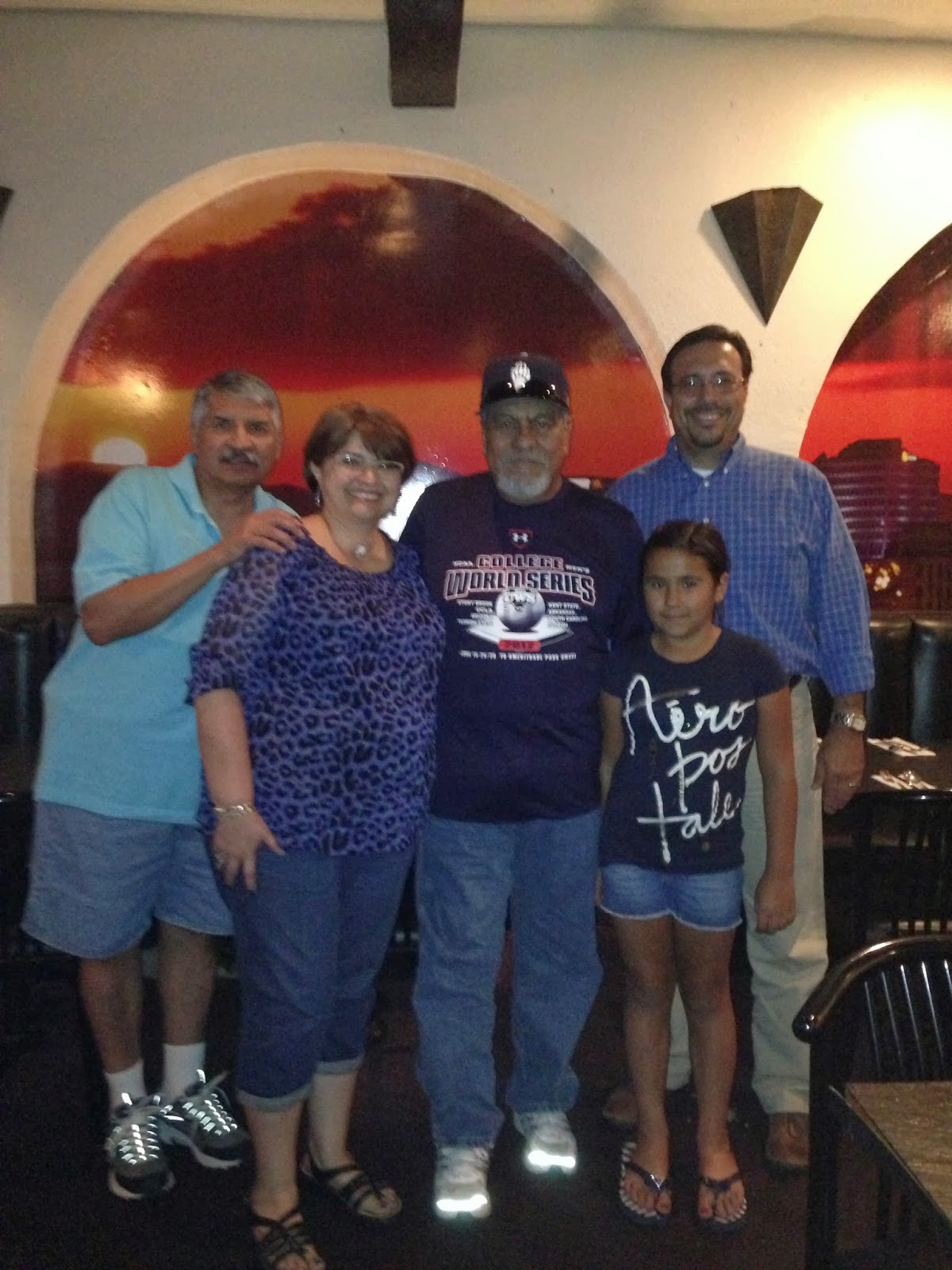
Luis, Barbara, Gil Sr., Gil Jr. & Isabella Gallegos
Fortunately, I heard from two cousins – the daughters of my Great-Uncle Clemente Gallegos. I first heard from Marissa Curnutte, and later traded e-mails with her sister, Barbara Gallegos. We shared many stories during the past year. This past summer, Barbara came to New Mexico from Arizona and we arranged to meet for lunch, along with my daughter, Isabella, my Dad and Barbara’s brother, Luis Gallegos, who lives in Albuquerque.

My Dad said he remembers visiting his cousins at their Las Vegas home, usually in the summers, when they spent time in their father’s hometown. They lived and attended in school in Peñasco, where their father, Clemente, taught at the high school.
 
Tina Rizkallah and Gilbert Gallegos
I was also fortunate to meet a more distant cousin, Tina Rizkallah, who lives in California. She determined that we are fourth cousins on my Mom’s side. Our common ancestor is Onofre Duran, who lived in Atrisco. Tina has relatives who live in the East Mountains. We met for lunch earlier this lunch when she was visiting.

More recently, I was surprised to hear from another cousin, Kathie Uribe, who is the daughter of Bennie Gallegos, another of my Grandpa Carlos’ brothers. I’m waiting to hear more from Kathie after the holidays. I’m especially excited because I know the least about her father, Bennie, and his brother, Arthur, other than they both served in the Navy in the Korean War, and they lived in California. Both my Dad and my Grandma Rise were especially fond of Uncle Bennie’s wife, Jeanne.

I also corresponded with a cousin, Adrianna Gallegos, who descends from Ignacio Gallegos, the younger brother of my Great-Grandfather, Luis Gallegos. I need to re-connect with Adrianna, who now lives in Nebraska, to learn more about that side of the family. I know that Ignacio was one of three legitimate children of Manuel Gallegos and Francisca Trujillo. My Great-Grandfather, Luis, and an older brother, Juan, shared Francisca as their mother. They both adopted the Gallegos name.

Of course, I’ve met at least a half-dozen other primos during the past three or so years that I have been researching my family tree. I appreciate hearing from all of my primos and sharing the rich history of our common families.


Friday, July 26, 2013

Don Manuel Gallegos and "Cajetito"

Don Manuel Gallegos and “Cajetito”

While I have established that my paternal surname is an adopted name, it’s still my family name, descending from a long line of Gallegos men – at least eight generations to Manuel Gallegos, who served as Alcalde Mayor of Santa Fe in 1761-63, shortly before his death.

I always assumed that since he held a prominent position in the local Spanish government of the capital city, there had to be more records about the Alcalde Mayor. No doubt, he must have been a descendent of the first Gallegos men who came to New Mexico in the mid-1600s, before the Pueblo Revolt. But I haven’t determined the identity of his parents.

I found a handful or records about Manuel’s time as mayor. But I recently came across more detailed estate records related to his death in 1763, thanks to the transcription of the Spanish Colonial records posted online by researcher Henrietta Christmas. Those estate records confirm my assumptions that Manuel Gallegos left plenty of material goods – worth about 1,075 pesos -- to his wife, Juana Maria Baca, and nine heirs when he died.

What I didn’t expect is one of those possessions was a servant named Joseph Antonio, known by the alias “Cajetito,” an Indian genizaro. I’m note sure of the origin of the nickname, which basically means little bucket. But the designation as Indian genizaro meant he was an Indian slave or servant, probably captured or purchased from a nearby tribe or pueblo.

That news on its own wasn’t a major surprise. Many prominent Spanish families in the 17th and 18th centuries, including my own Chavez ancestors, had servants. I have been meaning to write about the capture and trade of Indian children, and sometimes children of Spanish colonists. It is a complicated subject, and I have seen examples of both sides of the practice in my family tree.

The surprise in this case was two-fold: first it was a shock to see Joseph Antonio listed as a possession after the death of Manuel Gallegos; and second, the name Joseph Antonio suggests that perhaps this servant is the father of my own ancestor, Jose Antonio Gallegos, who was raised in the home of Manuel’s son, Manuel Gallegos Jr., in the early 1800s.

I know – it’s confusing. My paternal family tree, starting with myself, goes like this:
1.     Gilbert Gallegos, Jr.
2.     Gilbert Gallegos Sr.
3.     Carlos Gallegos
4.     Luis Gallegos (raised in the home of Manuel Gallegos)
5.     Manuel Gallegos
6.     Gregorio Gallegos
7.     Jose Antonio Gallegos (“criado” or raised in the home of Manuel Gallegos)
8.     (possible) Joseph Antonio, aka “Cajetito” (genizaro in the home of Alcalde Mayor Manuel Gallegos)

I can’t be certain whether my Gallegos line extends to Indian ancestors or the Alcalde Mayor Manuel Gallegos. And as I said, I already know through my DNA that my paternal heritage is linked to the original Duran y Chaves family. My Great-Grandfather Luis Gallegos was raised by a Gallegos family, but his own paternal ancestry is not known.

What is clear is that Luis Gallegos, and his ancestors before him, were raised with the Gallegos name – the same surname my grandfather, my father and I inherited.

While I have not determined the parents of Manuel Gallegos, the Alcalde Mayor of Santa Fe, this is what I know about him:

He was born about 1720, based on records that identified his age later on in life. Without his baptismal or marriage records, I have not found records identifying his parents or his place of birth.

He married Maria Josefa Baca, and they had nine children, including Manuel Antonio Gallegos, who was born in 1753. Manuel Jr. married Maria de la Luz Ortiz, and gave his Gallegos surname to Jose Antonio, my ancestor who was either Indian or a mix of Indian and Spanish.

Manuel Sr. served at Lt. Alcalde Mayor of Santa Fe in 1751 and 1752. A decade later, he was Alcalde Mayor and War Captain from 1761 to 1763.

Manuel Gallegos died on Dec. 29, 1763, according to the estate record transcribed by Henrietta Christmas. The next day, the Lt. Governor took an inventory of his holdings, followed several months later by the completed inventory, which was valued at 1,075 pesos:
Ø  One house that consists of four rooms, one large hall, one room, one kitchen and one store room,(150 pesos)
Ø  Built upon 30 varas of land with all its agricultural lands lying adjoining the house, that consists from north to south 400 hundred and some varas and from east to west 200 varas (100 pesos)
Ø  One old saddle with its equipment (40 pesos)
Ø  One old rifle with its case “San Miquelena.” (30 pesos)
Ø  One pair of spurs (6 pesos)
Ø  One leather jacket with six button holes (40 pesos)
Ø  One coat of Spanish cloth and pants of the same (45 pesos)
Ø  One pipe with an old gold stem (8 pesos)
Ø  One old hat (3 pesos)
Ø  One cloth cloak from “Queretaro” (15 pesos)
Ø  One axe (4 pesos)
Ø  One weaving frame (15 pesos)
Ø  Fourteen male mules and one unbroken mule (460 pesos)
Ø  One female burro (15 pesos)
Ø  One male mule that is to be paid by a servant of Vicar Santiago
Ø  Five pesos due him by Roque Lobato
Ø  Three pesos due him by the Indian Antonio Vigil
Ø  Joseph Antonio, alias “Cajetito” Indian genizaro
Ø  Due by Miguel Romero, deceased one cow and a calf (25 pesos)
Ø  Due by the deceases six varas of cloth to Bicente Martinez, soldier (6 pesos)
Ø  Due by deceased, to Pedro Rendon, three peso
The inventory was completed several months later:
Ø  Five male mules and serge cloth with trimmings (30 pesos)
Ø  Four pairs of shoes (8 pesos)
Ø  Two handkerchiefs (3 pesos)
Ø  One piece of cloth sufficient to make a cape (24 pesos)
Ø  One peso in soap (1 peso)
Ø  Two pounds of chocolate and two pounds of sugar (6 pesos)
Ø  One-half pound of bluing (2 pesos)
Ø  Three varas of ribbon (1.5 pesos)
Ø  Three canvas sheets for the patio (24 pesos)
Ø  One cotton shawl (5 pesos)
Said property being acquired by the sale of two male mules and six fanegas of piñon nuts, also five pesos in silver, which were delivered in good to the widow of the deceased Manuel Gallegos, six equipment’s with riata lassos (24 pesos)
Juana Maria Baca, the widow of Manuel Gallegos testified that she brought with her to the marriage: 156 ewes and a part in two ranches farming land that she inherited from her father and sold for 196 pesos


Tuesday, July 2, 2013

Juan Bautista Cordova

Juan Bautista Cordova has been a central figure in my genealogical research. It’s possible he’s my paternal great-great grandfather, which is one of two of the most surprising discoveries I’ve made about my family history.

However, it’s also possible – even probable – that I don’t descend from him at all. Even if I do, I recently discovered he may not be a Cordova himself; he was probably just raised by Luis Cordova in San Miguel del Bado in the early 1800s.
 
A cousin sent this photo of who he believes to be Juan Bautista Cordova in San Ignacio in the late 1800s
For me, the mystery of Juan Bautista started when I discovered that my great grandfather, Luis Gallegos, was baptized as the son of a Bautista Cordova and Francisquita Trujillo. That meant Luis is not a blood descendant of Manuel Gallegos. Rather, Luis was raised by Manuel Gallegos since at least the age of 10, while he was presumably the biological son of Bautista Cordova. Or was he?

The 1900 U.S. Census revealed a close relationship between the Cordova and Gallegos families. They lived together in the same home in the small village of Tecolotenos, in the mountains north of Las Vegas. The Census showed Juan Bautista Cordova as the 81-year-old head of household along with his son, Manuel Cordova, son-in-law Manuel Gallegos, daughter (and wife of Manuel Gallegos) Francisquita, and five Gallegos children ranging in age from 1 to 15.

But things didn’t add up. The two oldest Gallegos children, Juan Bautista and Luis (my great-grandfather) were born before the marriage of Manuel Gallegos and Francisquita. That’s when I dug further, and found baptismal records for both boys – Juan Bautista’s record did not list a father and his mother was Francisca Trujillo; and Luis was listed as the son of Bautista Cordova and Francisca Trujillo. That answered some questions, but raised new ones. Could the elder Juan Bautista Cordova, who would have been 71 in 1890, really fathered Luis? Seems doubtful. And why was Francisca listed as a Cordova herself – the daughter of Juan Bautista -- in previous Census records? It turns out she was a Trujillo, the daughter of Rafael Trujillo and Dulefina Chaves, but perhaps raised by Juan Bautista Cordova and his wife Altagracia. But who fathered her oldest children?

When I first discovered the Cordova connection, it was a surprise, and it turned into a running joke in my family. Were we really Cordova, and not Gallegos? What does that mean?

As I grappled with the meaning of the Cordova discovery, I made the other major finding of family history. After testing my Y-DNA, I was told that I definitely descend from the first Chaves family that settled in New Mexico in 1600.  Ironically, I descend from the same Chaves family on my mother’s side, as well. So, in the course of a few years, I went from Gallegos to Cordova to Chaves on my Dad’s side of the family.

Regardless of whether I really descend from Juan Bautista Cordova, I have still been obsessed with figuring out his family’s paper trail. Sometimes you never figure it out. Other times, you have to piece together different sources of information and draw educated conclusions. That’s what I’ve finally done with Juan Bautista Cordova, based on records as diverse as census records, church records, probate records in which he twice tried to adopt young boys – some 30 years apart; and an interesting 1875 land record in which Juan Baustista, his wife Altragracia, his son Antonio Cordova and his wife, Maria Gracia Jaramillo, sold land to a Frenchman named Juan Pendaries, who later created the Pendaries Resort that still exists in the mountains north of Las Vegas.

I traced Juan Bautista to his father, Luis Cordova (possibly the namesake of my great-grandfather Luis Gallegos?), through a church record that noted the 1837 marriage of Juan Bautista Cordova and Maria Hilaria Archuleta in San Miguel del Bado. I was never sure of that record because I only knew of Juan Bautista’s marriage to Maria Altagracia Trujillo. But the Pendaries land record confirmed that Antonio Cordova was Juan Bautista’s son, and looking again at Antonio’s marriage record in Mora, it listed Juan Bautista Cordova and Maria Hilaria Archuleta, who was deceased at the time of his 1859 marriage, as his parents. So Juan Bautista’s marriage to Maria Altagracia Trujillo was his second marriage. I haven’t found their marriage record, but they are first noted as godparents in the late 1840s in San Miguel del Bado. They were living in Tecolotenos by 1850.

With that mystery solved, I was able to figure out all of the children of Luis Cordova and his wife, Ana Maria Ulibarri. Well, I found records for all of their children except for Juan Bautista. Then, as I flipped through baptism records for San Miguel del Bado, I found a child simply named Juan Bautista, born on June 23, 1814, “de padres no conocidos,” meaning parents not known. It may be a bit of a stretch to think this is the same Juan Bautista, who must have been raised by Luis Cordova. But given all other evidence, and without evidence proving otherwise, it’s logical to conclude that this is the Juan Bautista I’ve been searching for.

Ultimately, at some point probably in the 1800s, a direct male descendent of the first Chaves family was the father of one of my more recent descendants. It’s possible that this unknown Chaves man was the father of Juan Bautista, but more likely, I suspect a Chaves man was the father of my great-grandfather, Luis. I say that because there is another Chavez man who is a perfect DNA match to me, which strongly suggests we share a common ancestor within the past four generations. I will continue to pursue that connection, however impossible it might seem.

Here is a timeline of my Cordova research:

23 Jun 1814    Juan Bautista born at San Miguel del Vado. His parents were listed as unknown; He may have been raised by Luis Cordova and Ana Maria Ulibarri

2 Dec 1837      Juan Bautista Cordova married to Maria Hilaria Archuleta at San Miguel del Vado. He was the 21-year-old son of Luis Cordova, deceased and Ana Maria Ulibarri

1838                Jose Antonio Cordova born in Las Golandrinas

(1839-1847)    Juan Bautista Cordova marries Altagracia Trujillo at San Miguel del Vado

18 Dec 1847    Juan Bautista Cordova and Altagracia Trujillo serve as godparents to Jose Camilo Gallego in San Miguel del Vado

1850                Mexico Census for Vayes de Tecolote:
§  Bautista Cordova, age 26
§  Maria Gracia Martin, age 22
§  Jose Antonio Cordova, age 10

(1851-54)        Manuel Cordova is born, based on later census records. He was the son of Juan Bautista Cordova, although a baptismal record has not been found. His 1929 death certificate listed his parents as Juan Bautista Cordova and Altagracia Trujillo.

29 May 1859  Jose Antonio Cordova married to Maria Gracia Jaramillo in Mora. He was the son of Juan Bautista Cordova and Maria Hilaria Archuleta

2 Mar 1861     Emiteria Cordova is born in Tecolotenos. She was the daughter of Jose Antonio Cordova and Maria Gracia Jaramillo

29 Mar 1863   Juan Cordova born is born in Tecolotenos. He was the son of Estipula Cordova and his godparents were listed as Juan Bautista Cordova and Altagracia Trujillo. This infant died 10 days later and the death record refers to him as the adopted son of Juan Bautista Cordova.

8 Aug 1863     Francisca Trujillo is born in San Miguel County. She is the daughter of Rafael Trujillo and Dulefina Chaves.

26 May 1864  Juan Cordova is born in Tecolotenos. He was the son of Jose Antonio Cordova and Maria Gracia Jaramillo

18 Dec 1875    Land record lists Juan Bautista Cordova as father and Jose Antonio Cordova as son. They sold land to Juan Pendaries for 500 pesos.

23 Aug 1885   Juan Bautista is born in San Ignacio. His father is listed as not known and his mother is Francisca Trujillo. His godparents are Antonio Cordova and Maria Gracia Garcia.

21 May 1890  Luis Cordova born. His baptismal records show him as the son of Bautista Cordova and Francisca Trujillo. He was raised by Francisca’s husband, Manuel Gallegos,.

18 Jun 1892    Francisca Trujillo marries Manuel Gallegos

6 Dec 1895      Probate record details Juan Bautista Cordova’s request to the San Miguel Probate Judge to adopt Juan Bautista II, a minor, who he said he raised from birth. I have not figured out for sure who the minor child was. Juan Bautista is listed as being widowed.

(1900-1910)    Juan Bautista presumably dies at some point in this decade. He is no longer listed in census records after 1900, when he said he was 81 years old.