Tuesday, July 31, 2012

Otero Family Tree


I often forget when I’m describing the genealogy of my relatives that the family connections are more easily understood when you see them on a pedigree chart. I spend so much time researching the relationships, I forget it is probably new to anyone who reads my blog, including relatives who know bits and pieces of the history.

My most recent post about Sister Mary Robert is a good example. I asked a cousin to read it, and she said she remembers her father saying Sister Mary was taken in as an orphan. She was taken in by her uncle, Melquiades Otero, apparently after the death of her father, Miguel Otero.
Sister Mary Robert


This is the pedigree chart for Eloisa Otero, later known as Sister Mary Robert. She shares the same grandfather, Gregorio N. Otero, as her cousin (my Great-Grandmother) Eliza Otero.

This is the baptismal record for Eloisa Otero. It shows she was the daughter of Miguel Otero and Maria Guadalupe Jaramillo. Her Padrinos were her Uncle Melquiades Otero and Aunt Beatriz Jaramillo, who would take her in prior to 1910 when her father died.
 
This is the pedigree chart for my Great-Grandmother Eliza Otero. Eliza married my Great-Grandfather Diego Antonio Chavez. Together, they were the parents of my Grandpa Louie Chavez.

Saturday, July 28, 2012

Sister Mary's Land Dispute


After finishing a meeting early last Friday in Washington, D.C., I took an opportunity to make a return visit to the National Archives. I went there for the first time in February, disappointed that I couldn’t locate the records I was interested in finding. But on Friday, the luck was on my side, as I was able to sneak in a request just before archivists pulled the final stack of records before closing.

However, I was in for a little bit of a surprise. While I thought I was getting Homestead records for my Great-Grandmother, Eliza Otero, I actually found records for Eloisa Otero, who was known later in life as Sister Mary Robert, a Catholic nun.

I have been gathering records on homesteads established in the 1800s and 1900s by my maternal Chavez and Otero families. I will write about those as soon as I can sort everything out. For now, I want to share what I found about Sister Mary Robert.

Growing up, I heard about Sister Mary Robert, who spent most of her life in El Paso. I knew she was my related to my Grandpa Louie, perhaps a cousin, but didn’t know exactly how they were related. My mother, Bea, said she remembered traveling to El Paso with her parents to visit Sister Mary. She had a very light skin complexion that made her look like a porcelain doll. She was very nice and my mom remembers Sister Mary would always visit them in Grants or Albuquerque with a traveling companion, another Sister from El Paso.

It turns out Sister Mary was my Grandpa’s aunt – the cousin of his mother, Eliza Otero. The land records confirm that Sister Mary was Eloisa Otero, the daughter and heir to Miguel Otero. I was confused by the 1910 Census record that showed Eloisa as the 8-year-old daughter of my Great-Great-Grandfather Melquiades Otero. But it now appears that Eloisa and her brothers, Mariano and Candido, were living with Meliquiades’ family, including my Great-Grandmother Eliza at the time, after their own father, Miguel, must have died. I assume their own mother, Maria Guadalupe Jaramillo, had also died and the kids were orphaned. I was able to confirm Eloisa’s heritage from her baptismal record, which showed her as the legitimate daughter of Miguel Otero and Maria Guadalupe Jaramillo.

The land records I got from the National Archives included a Homestead Patent application by Eloisa’s brother, Mariano Otero. The controversy arose because the land still belonged to Eloisa, who inherited it from her late father, Miguel. Eloisa was living in El Paso at the time, around 1927, and Mariano produced a record showing that Eloisa put him in charge of the land while she was away. The U.S. Department of Interior rejected the argument, and Mariano apparently got his sister, Eloisa, to sign another document attesting that she turned the land over to him for the sum of $1 while she was in El Paso.

“I, Eloisa Otero, known in religion as Sister Mary Robert, do this day, March 26, 1926, appoint my brother Mariano Otero with power to act in my stead as it is impossible for me to be present in Cubero, New Mexico at the present time.
                                                Signed Sister Mary Robert.”

I’m not clear of the ultimate result of the land dispute. A final certificate was issued on April 19, 1930 granting a small holding claim to Eloisa Otero. But the Department of Interior wrote in June of that year that if Mariano decided to challenge the validity of the title, he could do so in the local courts.

Another interesting fact I learned from these records is that Eloisa was under the guardianship of her cousin, Felix Otero, my Great-Grandmother Eliza’s older brother. Aside from losing her own parents, Eloisa also lost her uncle, Melquiades Otero, in 1915.

I’d like to find out more about Sister Mary’s life as a nun in El Paso. I’ll continue to look for more information and be sure to ask my Great-Uncle Lalo and my Great-Aunt Perla.

Monday, July 16, 2012

The Coldest Winter


Gilbert Gallegos at the North Korean side of the DMZ
Gilbert Gallegos on the South Korean side of the DMZ

Last month marked the 62nd anniversary of the start of the Korean War, when North Koreans crossed the 38th Parallel and invaded the South. One of the most astounding pieces of propaganda I was exposed to when I first visited North Korea in 2007 was the myth that every North Korean citizen is fed from childhood: They believe the United States invaded the North to start the war, and that the mighty military under Kim Il-Sung drove the Americans and South Koreans back to the Southern half of the Peninsula.

The truth is the communist North invaded the South and nearly drove its weaker military into the sea, despite the presence of American troops. But American reinforcements and tactical victories drove the North Koreans back. Once they gained an offensive advantage, the Americans under General Douglas MacArthur fought all the way to the northern border with China, where hundreds of thousands of Chinese soldiers were prepared to join the battle on the side of the North. The battles that ensued in the mountains of North Korea were horrendous. The Chinese pushed the Americans and South Koreans back down to the 38th Parallel, where the Americans were able to defend the capitol of Seoul. The war, officially called a “conflict,” unofficially ended with the signing of an armistice agreement, or cease-fire.  But officially, the war never ended.

I’ve written about my Grandpa Carlos and his brothers’ heroic fighting in World War II. It’s natural, I suppose, for me to view their participation in the Great War as heroic for a number of reasons, including the public perception that the world war was great and just. My Grandpa had two younger brothers, Bennie and Arthur Gallegos, who also fought in the Korean War. Aside from the fact that they served in the Navy, I don’t know any other details of their roles in what some have called “The Forgotten War.” I know they both survived and lived out their lives in California. I’ve done some looking, without success, for their war records. But I’ll keep trying.

In the meantime, I continue to digest everything I can read about the Korean Peninsula and its tragic history. My fascination with North Korea, in particular, started with my involvement with former Governor Bill Richardson, who has a long history of diplomacy with the Democratic People’s Republic of Korea, or DPRK. And it was during my first trip to North Korea that I opened my eyes and my mind to the history of the Korean War.

North Korean soldiers marching in 2007 in front of the Foreign Ministry Building
Our mission in 2007 was two-fold. The formal mission was to negotiate and take possession of the remains of several American soldiers who perished during the war, six decades ago. Our unofficial mission was to discuss the international stalemate over the DPRK’s pursuit of nuclear weapons. The talks about nuclear weapons were intriguing, to be sure, and involved representatives from the Bush White House and Department of Defense who joined us on the trip. I am currently reading a book written by that White House official, Victor Cha, who served as the Director of Asian Affairs with the National Security Council, which describes that 2007 mission from his point of view, along with an excellent analysis of the history of bad decisions by the DPRK. I traveled a second time to North Korea in 2010, also to discuss the nuclear issue, and to explore ways to ease tensions that had escalated to renewed threats of war between the North and South – while we were guests in Pyongyang.


Programme showing U.S. delegation, which car we were to use and our room number at Paekhwawon, North Korea's Official State Guesthouse

While I could go on about the intrigue and drama surrounding those issues, the most compelling thing that left a lasting impression on me was the remains of the American soldiers who fought in the Korean War.

During the three-year war, 33,692 Americans were killed. As many as 2.7 million Koreans and 800,000 Chinese were killed, according to statistics that Cha used in his book, The Impossible State: North Korea, Past and Future.

In 2007, our delegation sat across a table from a North Korean delegation known as the Panmunjom Mission of the Korean People’s Army, led by General Ri Chan Bok, North Korea’s Commanding General at the Demilitarized Zone. It was an interesting and oftentimes very tense discussion with the North Koreans agreeing with Governor Richardson that the issue of recovering and returning soldiers’ remains should not be political; yet at the same time, both the North Koreans and American governments have used the issue as a political football in negotiations over nuclear and other issues. The U.S. stopped participating in a joint effort to locate remains several years ago, and President Obama only recently offered to re-join the effort. But that participation is once again on hold as a result of North Korea’s most recent missile test.

Despite the high-state politics, I’ll never forget hearing General Ri, through a translator, as he read the names of American soldiers whose remains they found in the Unsan region. At the time, I had no idea of the significance of the Unsan region, in the far northwest region near the Chinese border, in the Korean War. Not until I returned home and read the book, The Coldest Winter, by the late, Pulitzer-Prizer winning author David Halberstam, did I truly understand what those soldiers must have went through as they were surprised by tens of thousands of Chinese soldiers at the Battle of Unsan. Many consider that battle to be the worst U.S. losses of the war.
North Korean Officers looking black boxes containing the remains of American soldiers who died in the Korean War

At the conclusion of our mission, we drove the 83 miles from Pyonyang south to the DMZ, where we saw for the first time the six black boxes that contained the soldiers’ remains. Images of that encounter were beamed around the world, but it was truly amazing to stand there and think about the soldiers who left home as young men nearly 60 years earlier, finally to return to American soil in those impersonal black boxes. We walked across the DMZ and were warmly greeted by the military leaders from the United Nations, United States and the South Korean Army. We flew in a Blackhawk to the military base near Seoul to have dinner with troops from New Mexico. The next day, we flew in a U.S. military jet from Seoul to Honolulu where we were met by a formal Arrival Honor Guard Ceremony to mark the transfer of the remains to U.S. territory. The remains were to be DNA tested at the base in Honolulu.

The experience was unforgettable, for sure. But it was much more profound after reading The Coldest Winter, which Halberstam reportedly considered his greatest work.

Now, every time I find, read or write something about my own ancestors who served our country in war, I have a very different perspective.

Sunday, June 24, 2012

First Communion


I’ve gone through more sacramental records that I can count in my ongoing effort to figure out my genealogy. Too often, as I’m searching for a nugget of information that helps my search, I become desensitized to the meaning of those records. I’m always amazed when I see an ancestor’s baptism or marriage record, and I wonder about the ceremony. But I don’t spend enough time thinking about what was really happening at that time in their lives.

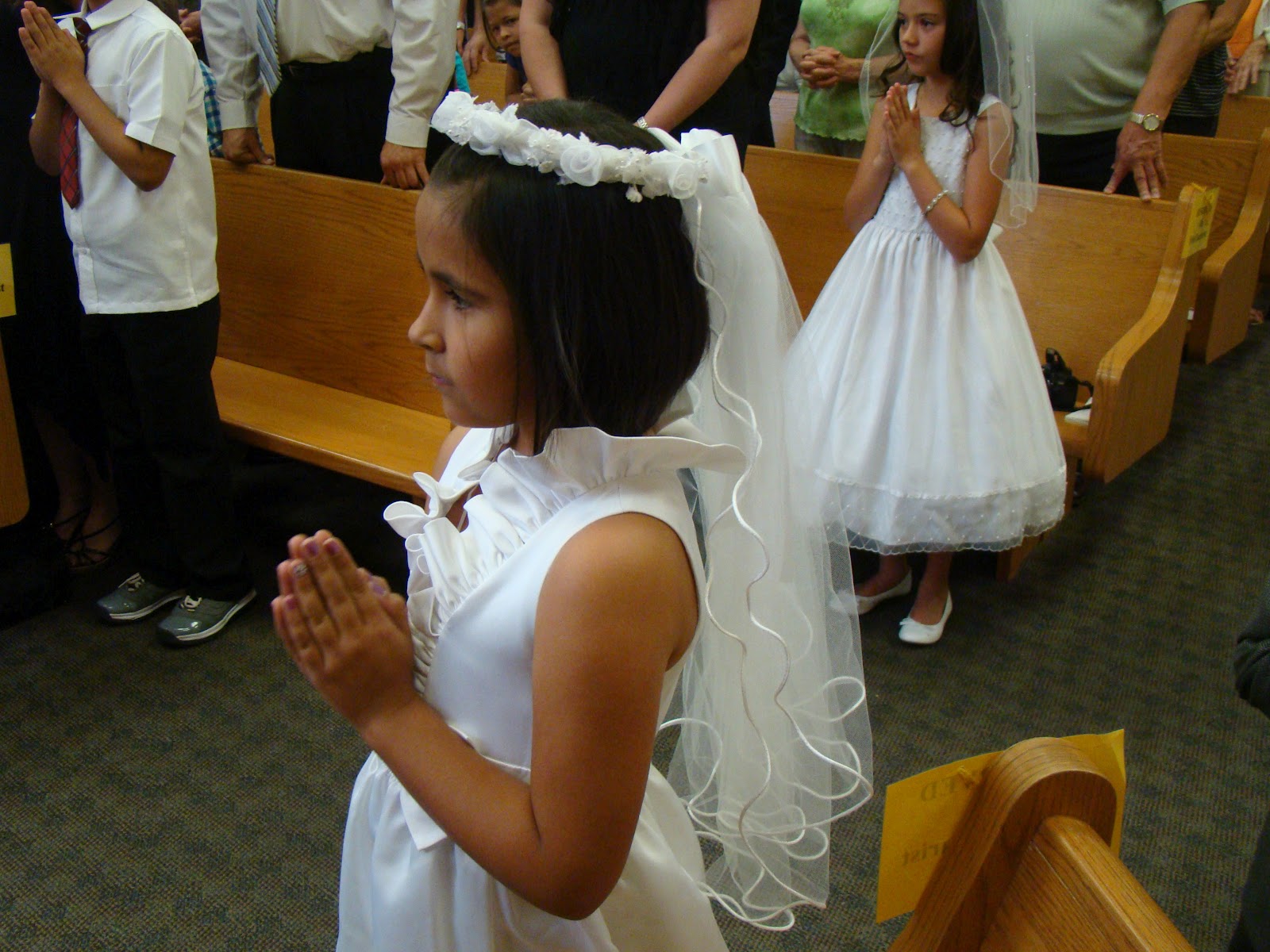
Isabella Lucia Gallegos
But today, the meaning became crystal clear. My youngest daughter, Isabella Lucia Gallegos, received her First Eucharist, or First Communion, at Risen Savior Catholic Community in Albuquerque. It was a big day for her, and she did a wonderful job. She is so curious and inquisitive. It warmed my heart and I know Yvette was touched as well to watch our little Bella learn about God, and to go on that journey with her. And of course she looked beautiful in her white dress, which she could hardly wait to wear.
Gil, Yvette and Isabella Gallegos
Gil, Yvette, Carin and Isabella Gallegos


Father Tim Martinez is new to our parish, and he did a great job communicating with the kids and making them feel loved.
Isabella with Father Martinez
Father Martinez blessing the children's rosaries and other gifts


Saturday, June 23, 2012

"Mexican" Vote


I’ve been involved in politics for nearly 20 years now. I covered many political races as a reporter and attempted to explore ethnicity in politics in a comprehensive way. In 2000, when Republican presidential candidate George W. Bush working hard to attract Hispanic voters, I remember being a little amused when he sent his Spanish-speaking, Hispanic nephew from Florida to New Mexico to make his pitch to Hispanics in Valencia County. During that same election, I drove to Mora County to write a story from the perspective of a Hispanic Republican sheriff who was successful in heavily Democratic Northern New Mexico. A few years later, I went to work for one of the most prominent Hispanic politicians in the country, Bill Richardson, who was twice elected governor of New Mexico and was the first Hispanic Democrat to run for President. I wrote dozens of speeches for Richardson about the role of Hispanics in national politics, during the 2004 election when John Kerry ran on the Democratic ticket; and in 2008 when Richardson came in fourth place in the Democratic primary that Barack Obama eventually won. More recently, I worked for Michelle Lujan Grisham, who is a 12th-generation New Mexican, as she beat out two other Hispanic candidates in the Democratic primary for the 1st Congressional District.

Needless to say, I thought I had a pretty good appreciation for Hispanic politics in New Mexico, even if I arrived on the scene long after many trailblazing, Hispanic politicians like U.S. Senators Dennis Chavez and Joseph Montoya. But what I didn’t realize was the role that ethnic, or “Mexican” politics played more than a century ago, and involving one of my ancestors.

The only Great-Grandfather I knew as a child was my Grandpa Tony, Antonio DeTevis, who was born in Las Gallinas and lived most of his life in Las Vegas. He was named after his own grandfather, Antonio DeTevis, who came to New Mexico from the Azore Islands, part of Portugal, in the early 1800s. The elder Antonio DeTevis apparently came here with his brother, Pedro Jose DeTevis, who became a well-known merchant in Taos. One of his claims to fame is the fact that he was good friends with Kit Carson and is buried next to Carson in Taos. But if you go to the cemetery there, you won’t find Pedro Jose. You’ll find a prominent grave marker for Peter Joseph DeTevis. For most of his life, Pedro went simply by Peter Joseph. He and his younger brother Antonio reportedly arrived from the Azores in New Orleans, moved up the Mississippi to St. Louis, and ended up in Taos. At some point in the 1830s or 40s, Pedro started going by the name Peter Joseph, an Anglicized version of Pedro Jose.
Peter Joseph (1814-1862) as shown in "Portuguese in the Old West"


It’s not clear why Peter Joseph Anglicized his name, but apparently it was not uncommon for Portuguese immigrants to do so. What has always been puzzling to me is the fact that Peter Joseph became such a successful merchant and land owner in Taos and associated with other non-natives like Carson, Charles Bent and Ceran St. Vrain; while his younger brother, Antonio, kept the DeTevis name and was otherwise anonymous in the history of Taos County and New Mexico.


Peter Joseph’s son, Antonio Joseph, was even more prominent in Northern New Mexico – in real estate and in politics. And the Anglicized Joseph name sometimes played a role in Antonio’s political career.

Antonio Joseph
Antonio Joseph served as a judge in Taos County and eventually moved to Ojo Caliente sometime after his father died in 1863. He inherited much of his father’s vast fortune and land holdings in Taos (including buildings on the Taos Plaza) and Rio Arriba counties, and eventually purchased most of the land that was part of the original Ojo Caliente land grant. He was elected to the territorial Legislature in the early 1880s. Then, he served 10 years as New Mexico’s delegate to Congress, from 1884-1894, apparently the first person of Portuguese descent to serve in Congress. After losing a re-election bid in 1894, Joseph served in the territorial Council, the predecessor of the state Senate, and served as President of the Council in 1898.

Antonio Joseph had many friends, but also made political enemies. One such adversary was L. Bradford Prince, who in 1884 was a former state Supreme Court justice and would later serve as Governor of the territory. But in that year, he was the Republican opponent to Antonio Joseph a Democrat, in a three-way race for delegate to Congress.

Apparently, Prince tried to use Antonio Joseph’s ethnicity against him in that congressional race, according to former Governor and former Congressional Delegate Miguel Antonio Otero, who wrote about the encounter in his book “My Life on the Frontier.” Otero said in his book that he obtained an original letter that Prince sent to a political ally, Judge Shaw, in Socorro County. In that letter, marked confidential, Prince writes about the importance of the “Mexican” vote in the upcoming election.

“The Mexican vote, under the circumstances, is very important,” Prince writes to Shaw. “I think much can be done by printing tickets with my name at the head.” Prince goes on to suggest that if he is elected, “…our fellows will be on top for a good while, and you can be sure that anything in the way of patronage will go where there are obligations. I believe in standing by one’s friends. You can do an enormous amount by the display of the tact you have in such things.”

What exactly was Prince suggesting? He spells it out in an enclosed note, marked “strictly confidential.”

“There has been so much said as to Joseph’s name that every one understands that his real name is DeTevis and many newspapers have suggested that probably a ticket to be legal should be printed Antonio Joseph DeTevis. The Democratic tickets are printed simply Antonio Joseph. Now, if Democratic tickets are printed, say in Socorro, quietly, with the name Antonio Joseph DeTevis at the head, and sent out in proper packages addressed to the Democratic committeeman in precincts (not in Socorro or where any leader lives) so as to arrive shortly before the election, it would appear to be the revised and corrected ticket, and certainly would be used in some places. This would divide the vote. Of course places having telegraphs should be avoided.”

Former Governor Otero minced no words in his book about Prince’s tactics.

“I have this original letter and suggestion in my possession, written in the handwriting of L. Bradford Prince, and it was my opinion that any man who resorted to such methods was absolutely unfit to hold any position within the gift of the people. Prince’s tactics were well known to everybody in New Mexico. He would run down anyone whom he thought was in his way and had no hesitancy in telling a deliberate lie, if by so doing he might benefit.”

It’s not clear what, if anything, happened as a result of Prince’s suggestion. There were tickets printed with the DeTevis surname in San Miguel County, although they were Spanish-language tickets. I supposed it’s possible that Antonio Joseph benefited from those tickets because of his Iberian ancestry. Ironically, the so-called “Mexican vote” in 1884 probably similar to the “Hispanic” or “Latino” vote in 2012 – is not so easily defined. In fact, there was nothing “Mexican” about Antonio Joseph, who was born in St. Louis to a Portuguese father and a mother who was at least part Black and was Peter Joseph’s servant, and possibly slave, before the family moved to New Mexico where they were married and Antonio was baptized.


Saturday, June 9, 2012

Letters from the Battlefront


Like many small-town newspapers around the country during World War II, the Las Vegas Optic published letters that local soldiers sent home from the battles raging in Europe and the Pacific. I came across some of those letters recently as I looked through microfilm images of the Optic from the 1940s. I was looking for a birth announcement for my father in 1944 (which I did not find because those editions of the newspaper were missing), when I stumbled across the letters from the battlefront. Then it occurred to me that maybe my Grandpa Carlos Gallegos was at war when my Dad, Gilbert Gallegos, Sr., was born in Las Vegas. I asked my Grandma Rise about it, and she said my Grandpa was indeed away when my Dad was born, but he wasn’t in Europe. He was in the States in officer training school. She said my Grandpa returned to Las Vegas two days after my Dad was born, and had to return to his base soon afterward.

Carlos Gallegos
I told my Grandma that I found a reference in the Optic to a letter that my Grandpa sent to her. According to the newspaper, “Lt. Carlos Gallegos has arrived safely in England, according to a letter received by his wife here. He wrote that he was surprised to meet his brother, Cpl. Clem Gallegos, on the ship and they were together for the voyage. They had not seen each other in three years.”

I didn’t find any other letters from my Grandpa while he was in Europe, although several months were missing from the archived copies of the Optic. My Grandma said she used to have a stack of letters that they wrote to each other. She specifically remembered my Grandpa telling her that he was reading one of her letters as he lay in a bed inside a home in the countryside of France when artillery started exploding around him. “He said that one time he was laying on the bed in a house that they found, reading a letter, then bomp, bomp, bomp, they started shooting and they nearly killed him,” she told me.

I did find a note in the Optic from Jan. 30, 1945 that read: “Mrs. Carlos L. Gallegos has returned from Leesville, Louisiana where she visited her husband Lt. Carlos Gallegos, the past two months.” I asked my Grandma about all of her traveling during the first few years of her marriage, as my Grandpa trained to be a Lieutenant in the Army. She said the train travel made her sick as she criss-crossed the country, going to Texas, Washington State and Louisiana and back to her beloved Las Vegas.

Clemente Gallegos
I came across a few letters from, and updates about, my Grandpa’s brother Clemente. One letter informed his wife and parents that Clemente was recovering from being shot by German forces in Italy in December 1943, just five months after his brother, Eloy, was killed during Operation Husky.

The Optic on Jan. 13, 1944, reported:
“Mr. and Mrs. Louis (sic) Gallegos, 1424 10th Street, have received word that their son, Cpl. Clemente Gallegos, who was wounded in action in Italy on December 20 is getting along well. Corporal Gallegos is a brother of Sgt. Eloy Gallegos, who was killed in action in the Sicilian campaign on July 10, 1943. Another brother, Lt. Carlos Gallegos, is stationed at Seattle, Washington. Two letters were received from Corporal Gallegos yesterday, one to his wife and one to his parents. In the letter to his parents, he wrote: ‘One more Christmas season has fallen back to the pages of history and me so far away from home. But if God is willing on the next one I will be back home with you to help you celebrate it. I can’t say that I did not appreciate this Christmas, for I did. With presents from back home plus those of the Red Cross the spirit of Christmas was high among all of us. I thank you all for your thoughtfulness in sending me what you did. My only regret is not sending any to you. I have prayed that you all enjoyed a happy Christmas and also a happy New Year. Do not worry about me for I am doing well. Give my best regards to all my friends.’”

April 4, 1944
“Mrs. Clemente Gallegos, 1016 Tilden, has received the Purple Heart which was awarded to her husband, Cpl. Clemente Gallegos, who is a former member of the 120th Engineers, National Guard. Corporal Gallegos was wounded in action in Italy December 20, 1943.”

April 1, 1945
“Corporal Clemente Gallegos is reported to have been wounded a second time in combat according to official notice to his wife who resides at 1016 Tilden. Cpl. Gallegos suffered his first combat injury in Italy in 1943. He returned home for a brief furlough during December 1944 and returned to active duty in Germany where he was wounded in action on March 26.”

June 1945
“Cpl. Clemente Gallegos, son of Mr. and Mrs. Louis (sic) Gallegos of Las Vegas has arrived home on a 30 day convalescence furlough. Gallegos served for 18 months in the European theater before coming home in December on a rotation furlough. He returned to Germany and was wounded while crossing the Rhine. He wears the Purple Heart with an Oak Leaf cluster, the ETO ribbon with five campaign stars, pre-Pearl Harbor ribbon and the Good Conduct medal. At the end of his furlough he will return to Brooks General Hospital, Ft. Sam Houston, Texas.”

Tony DeTevis Jr.
I also found news reports of other relatives in the Optic. The paper reported that “Tony De Tevis, Jr., (my Grandma Rise’s oldest brother) was honorably discharged from the Army June 10, 1945, under the point system.”

The Optic also reported a fascinating story about my Grandma’s cousin, Hilario LeDoux who was serving in the Pacific.

April 11, 1945
“With the 24th Infantry (Victory) Division in the Philippines – (Special) – A nightmare of Jap rule by robbery and murder died by the sword when Pfc. Hilario LeDoux of Las Vegas, N.M. and his buddies assault on Romblon Island in the Philippines wiped out a band of Jap gangsters. Life on Romblon had been peaceful and prosperous until Jap fugitives from the American advance selected this picturesque isle as a hideout. The invaders forced the native population to feed them with death decree for those who refused to surrender rice. Then came relief. As a member of a task force, LeDoux landed on Romblin in the pitch black of a torrential night rain, then marched across miles of rough jungle country to surround the town of Romblon. At dawn, sudden machinegun and mortar fire from palm-studded slopes drove the enemy out of stolen houses. Japs dashed for the cover of hillsides, where the advancing riflemen welcomed them with blasts of hot lead. Dead Nips littered the edge of the town sa LeDoux and his buddies pushed into the streets in a house-to-house routing of snipers. The people greeted their liberators with unrestrained jubilation.”

Monday, May 28, 2012

Blame it on the Tamales


Grandpa and Grandma Chavez at Christmas -- enjoying a tamale
When my Grandpa Louie (Chavez) had an upset stomach, he used to say: “Me hizo mal los tamales.” In other words, he blamed it on the bad tamales, which was an inside joke referring to the day after his wedding when my Grandma Lola wasn’t feeling well. According to my Grandma, it was the tamales. But my Grandpa blamed her queasiness on the Champaign, mostly because my Grandma never drank alcohol.

That old saying resurfaced last month when I was visiting with family during my cousin Phoebe’s first birthday. I was telling my relatives about the 1940 Census that was released earlier in April. One of the surprises I discovered, based on math from reading the Census and other records, was that my Grandma Lola was pregnant with my Aunt Fran when she and my Grandpa married in 1941.

When I mentioned my discovery at the party, my Uncle Mike practically jumped out of his seat. He concluded it wasn’t the tamales that made my Grandma sick; it was her pregnancy. My mom was equally shocked, but for another reason. Like my Grandma, my mom had an unexpected pregnancy – with me. And she said her mother gave her such a hard time about it. She couldn’t believe her mother would treat her that way, given her own history. Of course, those were different times – in 1941, as well as in 1969, when I was born.

I also asked my Mom whether she had seen a wedding picture of my Grandpa and Grandma. She said the only photo she remembered was a photo of her parents with her Uncle Lalo in El Paso, shortly the wedding. I discovered through church records that they got married in San Fidel, outside of Grants where they lived. They must have taken a honeymoon in El Paso, before moving to Los Angeles, which is where my Aunt Fran was born.

Even with family stories and all of the research I’ve done, it’s always tough to know the circumstances surrounding most of the life-changing events of my ancestors. For example, in 1940-41, they were recovering from the Depression and heading toward a world war. My Grandpa had just lost his father a year before, and his oldest brother died four years earlier. Before he knew it, he was start a new life of his own. Unfortunately, another brother would die after they moved to L.A.

Following the death of his brother, Benny, my Grandpa was thrust into a difficult situation with the responsibility of two families – taking care of his mother and his remaining siblings; and his wife and infant daughter. His mother, Eliza, was a strong-willed woman. But I can attest that my Grandma Lola was just as strong-willed, some might say stubborn (of course I would never say that.) 
Eventually, my Grandpa and Grandma moved back to New Mexico, where my mom and her three brothers were born and raised. Great-Grandma Eliza and her youngest son, Lalo, remained in L.A.
My grandparents lived the next 60 years in New Mexico, moving from Grants to Albuquerque and finally to Farmington. They had some bad tamales, I’m sure, but all I remember were my Grandma’s wonderful tamales every Christmas – either at her house, at my Aunt Fran's, or at our house in Albuquerque.